
Notable Quotable 427

What difference does it make to the dead, the orphans and the homeless, whether the mad destruction is wrought under the name of totalitarianism or in the holy name of liberty or democracy?
- Mahatma Gandhi
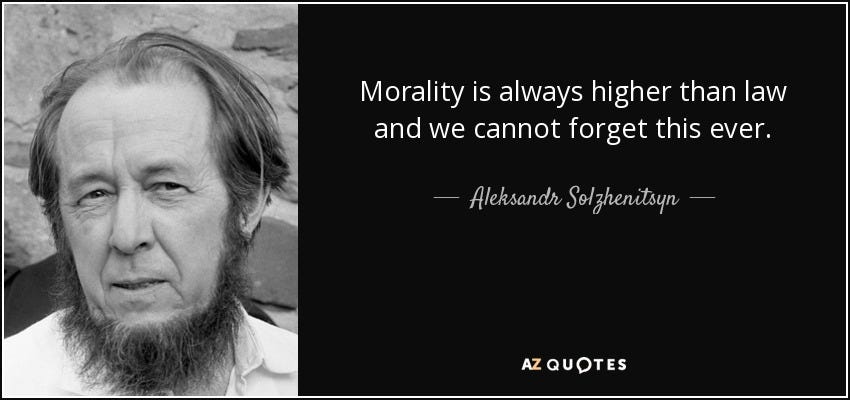
And how we burned in the camps later, thinking: What would things have been like if every Security operative, when he went out at night to make an arrest, had been uncertain whether he would return alive and had to say good-bye to his family? Or if, during periods of mass arrests, as for example in Leningrad, when they arrested a quarter of the entire city, people had not simply sat there in their lairs, paling with terror at every bang of the downstairs door and at every step on the staircase, but had understood they had nothing left to lose and had boldly set up in the downstairs hall an ambush of half a dozen people with axes, hammers, pokers, or whatever else was at hand?… The Organs would very quickly have suffered a shortage of officers and transport and, notwithstanding all of Stalin’s thirst, the cursed machine would have ground to a halt! If…if…We didn’t love freedom enough. And even more – we had no awareness of the real situation…. We purely and simply deserved everything that happened afterward.
- Aleksandr Solzhenitsyn
Intolerance of oppression, the desire to be free and develop one personality to its full limits, is not enough to make one an anarchist. That aspiration towards unlimited freedom, if not tempered by a love for mankind and by the desire that all should enjoy equal freedom, may well create rebels who soon become exploiters and tyrants.
- Errico Malatesta
Live a good life. If there are gods and they are just, then they will not care how devout you have been, but will welcome you based on the virtues you have lived by.
If there are gods, but unjust, then you should not want to worship them.
If there are no gods, then you will be gone, but will have lived a noble life that will live on in the memories of your loved ones.
- Marcus Aurelius


To laugh often and much; to win the respect of the intelligent people and the affection of children; to earn the appreciation of honest critics and endure the betrayal of false friends; to appreciate beauty; to find the beauty in others; to leave the world a bit better whether by a healthy child, a garden patch, or a redeemed social condition; to know that one life has breathed easier because you lived here. This is to have succeeded.
- Ralph Waldo Emerson
When human nature rebels against Mother Nature, humanity becomes a cancer on the earth. The natures of all things are nested within nature as a whole. When you reject what life gives you, you place yourself in opposition to nature—including your own nature—and so harm yourself.
- Marcus Aurelius
Temptations, discouragement and unrest are the wares offered by the enemy. Remember this: if the devil makes noise it is a sign that he is still outside and not yet within. That which must terrify us is his peace and concord with the human soul. That which comes from Satan begins with calmness and ends in storm, indifference and apathy.
- Saint Padre Pio
The homemaker has the ultimate career. All other careers exist for one purpose only - and that is to support the ultimate career.
- C.S. Lewis


Government IS slavery. Is now, always has been, always will be.
- Mark Passio
Ways to connect
PGP : 7351 9c62 95cc 8130 d8b1 c877 ec99 9aaf 5b1f b029
Email: thetruthaddict@tutanota.com
Nostr: thetruthaddict@nostrcheck.me
npub1mw8jj8w0jjfh8afzgpcvhm604wqtn2xngdpydt9plc6pznx9rhgqny59rj
https://joel-walbert.npub.pro/
Telegram: @JoelWalbert
The Truth Addict Telegram channel
Hard Truth Soldier chat on Telegram
The Truth Addict Media Archive (downloadable documentaries, interviews, movies, TV, stand-up, etc)
Mastodon: @thetruthaddict@noauthority.social
Signal: @nemesis.44
We Talk You Listen: The Truth Addict
Odysee: TruthAddict
Rumble: thetruthaddict09
Bitchute: The Truth Addict
Donations (#Value4Value)
Buy Me a Coffee (One time donations as low as $1)
Monero:
875NjAR76kqDeSXdWUJ5S5AuH7z98XrmL1ZEpqPGpJ9JP3uvK9XNsJGFYGYwL3yNAoPnojuJbGamp7FxuLgEuvecJdqZHEL
Bitcoin:
+tamechannel82 (paynym)
bc1qkk6sf9u68etyr3mu7cq9xcu794nquda8mn8dw6
thetruthaddict@rizful.com (lightning)

I found this post especially thoughtful, and it brought several themes together in a way that invited synthesis. Here’s the reflection it prompted:
Human beings have always struggled with the tension between power and freedom, and the labels under which violence is committed do nothing to change its effects on the dead, the dispossessed, or the oppressed. History shows, as Solzhenitsyn observed, that tyranny thrives when people submit in fear rather than resist in solidarity, and that the machinery of oppression depends less on the strength of the state than on the passivity of the population. Yet the desire for freedom, as Malatesta warned, is not enough by itself; unless it is universalizable — unless one seeks freedom for all rather than merely for oneself — it easily degenerates into a new form of domination. The Stoics remind us that virtue does not depend on metaphysical guarantees or divine approval; a life lived in accordance with reason, courage, and justice is its own justification, whether or not gods exist. To live well is to align oneself with the nature of things, to accept what one cannot change, and to cultivate the character that allows one to act rightly in the face of adversity. These insights converge on a single point: the moral life is not measured by slogans, identities, or political banners, but by the clarity with which one sees the world, the courage with which one resists injustice, and the steadiness with which one commits to universalizable principles of freedom and virtue.